Common Zoho Implementation Mistakes Businesses Must Avoid in 2026
Businesses today are rapidly adopting digital transformation solutions to improve operations, automate workflows, and increase productivity. Platforms like Zoho have become popular because they offer integrated applications for CRM, finance, customer support, HR, analytics, and operations management.
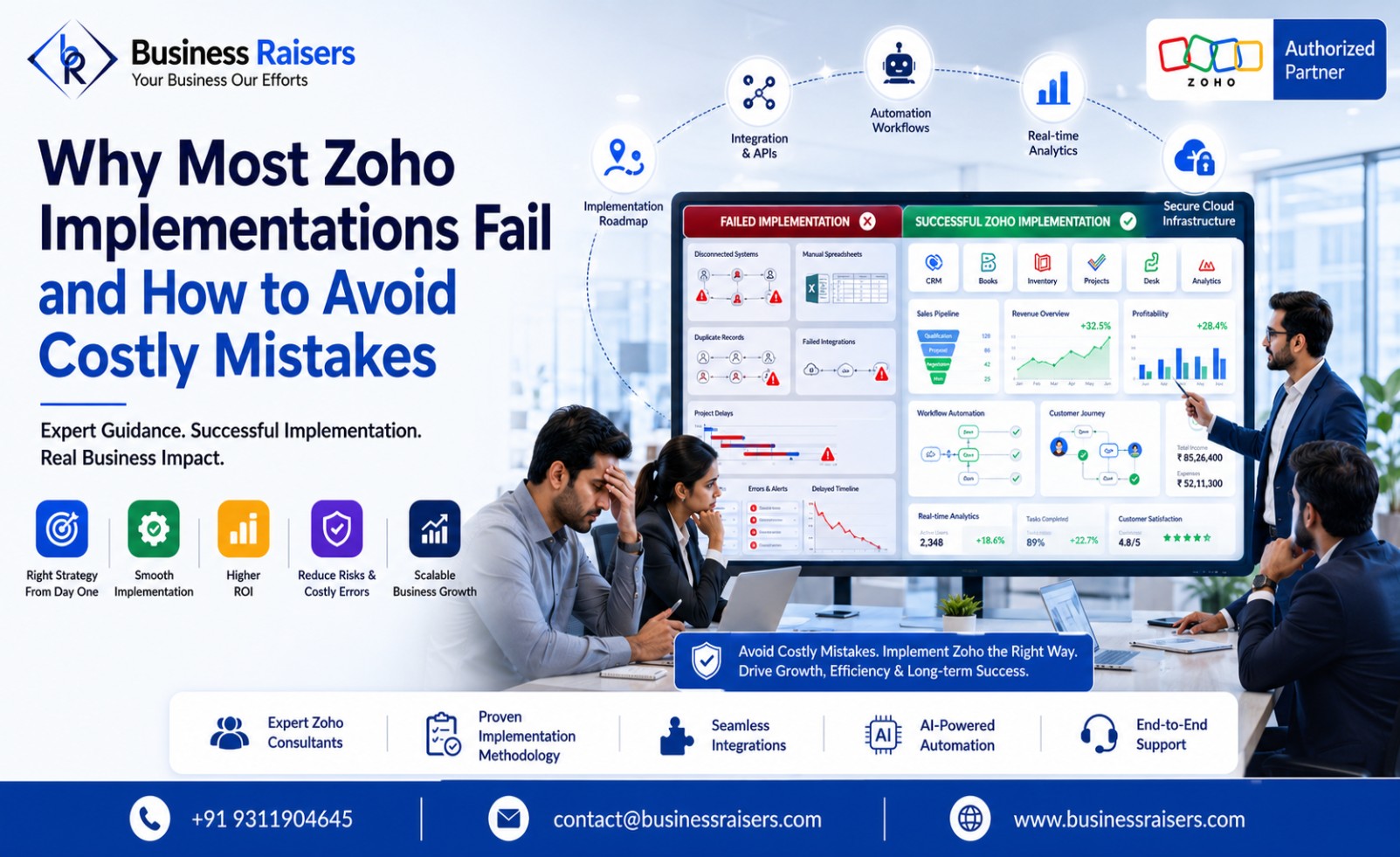
However, many companies fail to achieve expected results due to poor implementation strategies. Simply purchasing software is not enough. Without proper planning, customization, integration, and employee training, organizations often face workflow inefficiencies, low user adoption, and operational challenges.
This is why many businesses now rely on Business Raisers, an experienced zoho consulting partner, to ensure successful deployment and long-term optimization.
Lack of Clear Business Requirements
One of the biggest mistakes businesses make is starting implementation without properly defining operational requirements.
Many organizations fail to identify:
Workflow challenges
Automation requirements
Reporting expectations
Department-specific processes
Integration needs
Long-term scalability goals
Without clear planning, businesses often end up with systems that do not align with actual operational needs.
How to Avoid This Mistake
Businesses should conduct detailed requirement analysis before implementation begins. Business Raisers helps organizations identify operational gaps and build workflows aligned with business goals.
Choosing Incorrect Applications
Zoho offers a large ecosystem of applications, including CRM, finance, HR, support, analytics, and ERP solutions.
Many companies implement unnecessary applications while ignoring important operational requirements.
For example:
Implementing CRM without automation planning
Using finance software without inventory integration
Ignoring support management tools
Deploying disconnected systems
Professional consultation helps businesses choose the right applications according to operational structure and future growth requirements.
Poor CRM Configuration
CRM implementation failures are common when businesses use default settings without proper customization.
A poorly configured CRM system often causes:
Disorganized customer data
Inefficient sales pipelines
Incorrect lead tracking
Manual follow-ups
Poor reporting accuracy
Many organizations underestimate the importance of proper CRM planning and automation.
Solution
Business Raisers provides expert zoho crm implementation services to configure lead management, automation workflows, dashboards, and reporting systems according to business requirements.
Ignoring Workflow Automation
One major reason businesses adopt Zoho is automation. However, many companies continue using manual workflows even after implementation.
This limits productivity improvements and increases operational inefficiencies.
Common Automation Mistakes
Manual invoice approvals
Manual lead assignments
No task automation
Delayed follow-up reminders
Manual support ticket routing
Automation should always be planned during implementation to maximize efficiency and reduce repetitive work.
Lack of Proper System Integration
Disconnected systems are one of the biggest causes of operational inefficiency.
Many businesses fail to integrate applications with:
Accounting systems
Ecommerce platforms
Inventory management
HR systems
Customer support platforms
Marketing automation tools
Without integration, organizations often experience duplicate entries, inconsistent data, and communication gaps between departments.
Business Raisers helps companies build a connected ecosystem that improves collaboration and operational visibility.
Insufficient Employee Training
Even the best implementation can fail if employees do not understand how to use the system effectively.
Many businesses focus only on technical deployment while ignoring user training and adoption.
Problems Caused by Poor Training
Low software adoption
Increased user errors
Resistance to new systems
Reduced productivity
Inconsistent workflow usage
Proper onboarding and employee training are essential for successful implementation.
Over-Customization of the System
Customization is important, but excessive customization can create long-term operational problems.
Some businesses unnecessarily modify workflows, modules, and interfaces beyond actual requirements.
Risks of Over-Customization
Increased maintenance complexity
Difficult future upgrades
Slower system performance
Higher implementation costs
User confusion
Businesses should focus on practical customization aligned with operational goals rather than unnecessary complexity.
Ignoring Data Migration Planning
Data migration is one of the most critical stages of implementation.
Poor migration planning often leads to:
Missing customer data
Duplicate records
Incorrect financial information
Incomplete historical records
Workflow disruptions
Businesses should validate and clean existing data before migration to ensure accuracy and consistency.
Not Planning for Future Scalability
Many businesses implement systems only for current requirements without considering future growth.
As organizations expand, operational complexity increases.
Scalability Issues Include
Limited automation capabilities
Inflexible workflows
Poor reporting structures
Lack of department integration
Performance limitations
Scalable implementation strategies help businesses support long-term operational expansion.
Weak Customer Support Management
Customer support plays a major role in customer satisfaction and retention. However, many organizations fail to optimize support workflows during implementation.
Common Mistakes
No ticket automation
Delayed response tracking
Poor communication workflows
Lack of reporting visibility
Business Raisers helps businesses improve customer support operations with optimized workflows and automation strategies.
No Ongoing Optimization Strategy
Implementation is not a one-time process. Business requirements evolve over time, and systems require continuous improvement.
Why Ongoing Optimization Matters
Business processes change
Teams grow
Reporting requirements evolve
Automation needs increase
Integration requirements expand
Regular optimization helps businesses maintain efficiency and maximize software performance.
Conclusion
Zoho provides powerful business applications that help organizations automate operations, improve productivity, and support long-term growth. However, implementation mistakes can reduce efficiency and create operational challenges.
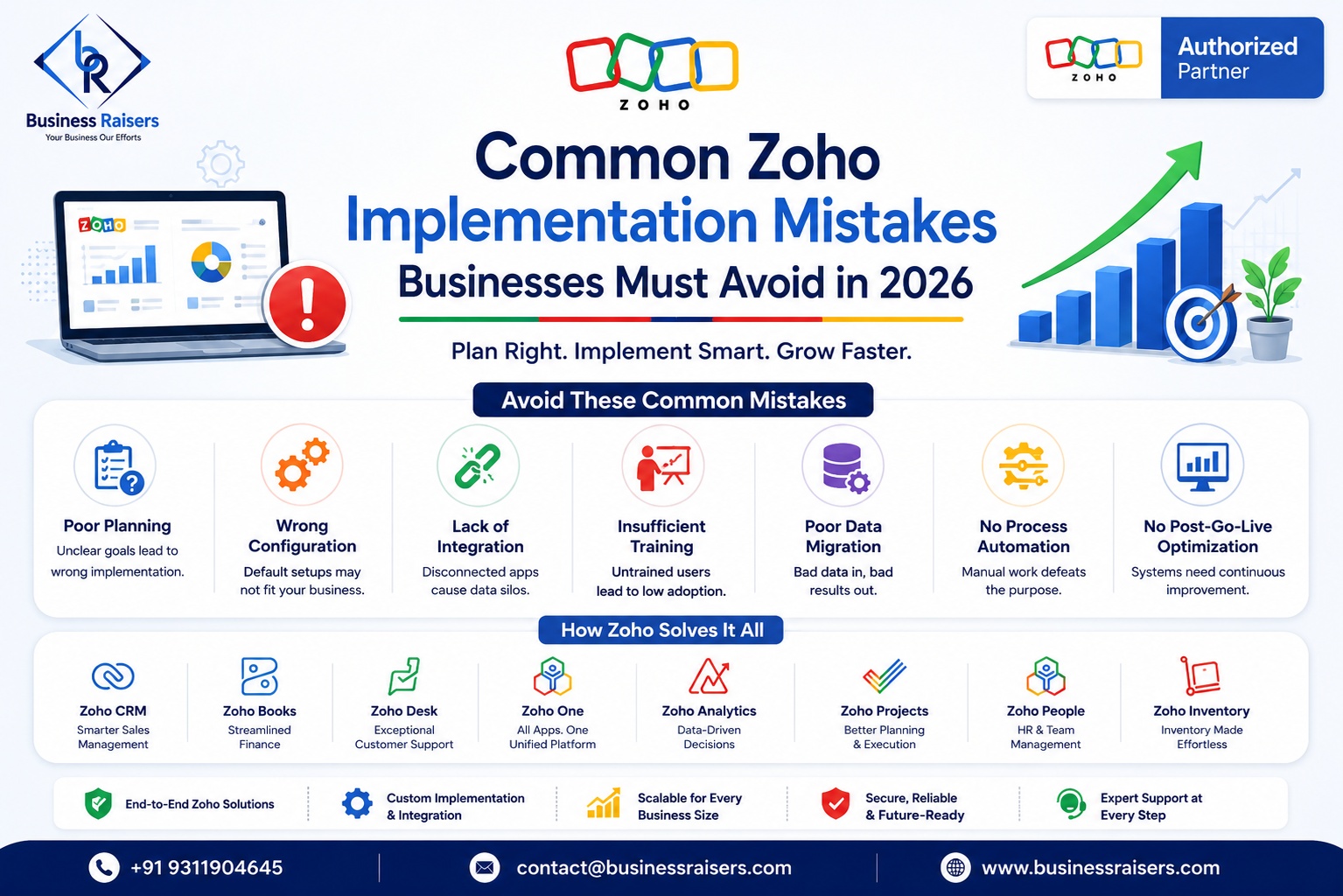
Common issues such as poor planning, weak CRM configuration, lack of automation, improper integrations, insufficient training, and over-customization often prevent businesses from achieving expected results.
By working with experienced implementation experts, businesses can successfully deploy scalable systems that improve operational efficiency and business performance.
In 2026, companies that focus on proper strategy, automation, integration, and continuous optimization will gain a significant competitive advantage in the digital business environment.
FAQs
1. What are the most common Zoho implementation mistakes?
Common mistakes include poor planning, incorrect CRM setup, lack of automation, weak integrations, insufficient training, and poor data migration strategies.
2. Why should businesses work with a consulting partner?
An experienced implementation partner helps businesses customize, integrate, and optimize applications according to operational requirements.
3. Why is CRM implementation important?
Proper CRM implementation improves lead management, sales tracking, automation workflows, reporting accuracy, and customer relationship management.
4. How does integrated implementation help businesses?
Integrated implementation connects multiple applications into one centralized ecosystem for improved collaboration and operational efficiency.
5. Why is scalability important during implementation?
Scalable systems support future growth, advanced automation, better reporting, and efficient cross-department operations.
6. Why is employee training necessary after implementation?
Employee training improves user adoption, reduces operational errors, and ensures teams use the system efficiently.