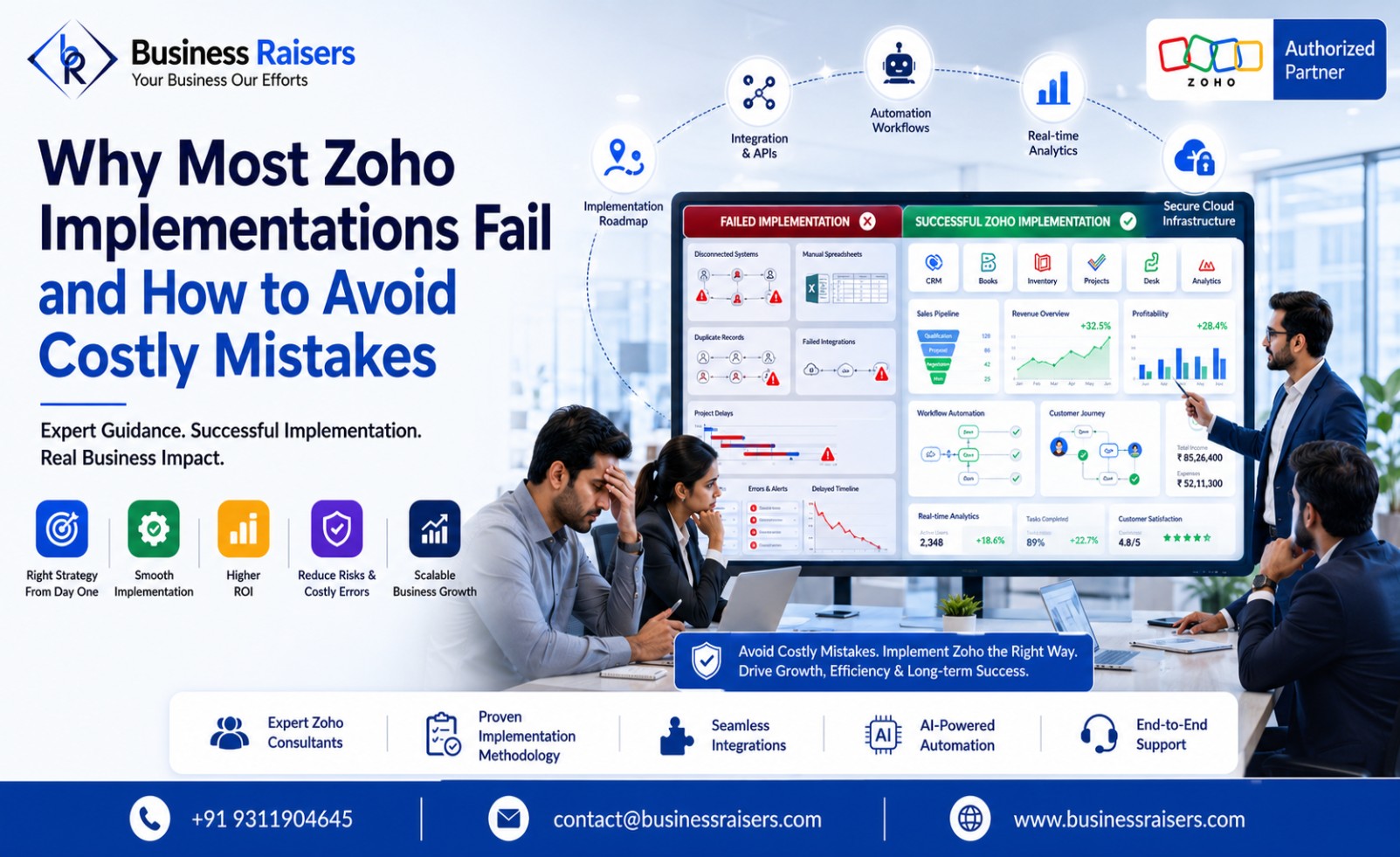
Why Most Zoho Implementations Fail and How to Avoid Costly Mistakes
Businesses invest in Zoho to improve productivity, automate workflows, and streamline operations. However, simply purchasing software does not guarantee success. Many organizations struggle to achieve the expected return on investment because their implementation lacks proper planning, process alignment, or user adoption. A successful Zoho deployment requires more than installing applications—it demands a strategic approach tailored to business goals. Business Raisers helps organizations maximize software performance through expert zoho implementation services, ensuring every deployment supports long-term business growth and operational efficiency.
Why Do Zoho Implementations Fail?
Zoho offers a comprehensive suite of applications that can transform sales, finance, customer support, HR, and project management. Despite its flexibility, implementation failures are surprisingly common. The primary reason is that businesses focus on technology instead of business processes.
When software is deployed without understanding operational requirements, employees continue using manual methods, data becomes inconsistent, and automation fails to deliver meaningful results. Implementation should begin with business objectives rather than software features.
Lack of Clear Business Requirements
One of the biggest implementation mistakes is starting a project without defining clear goals. Many companies attempt to replicate existing manual processes without identifying opportunities for improvement.
Before implementation begins, organizations should answer questions such as:
Which business processes need automation?
What challenges are employees facing?
Which departments will use the system?
What reports does management require?
How will success be measured?
Having clear objectives helps create an implementation strategy that delivers measurable business value.
Ignoring Existing Business Processes
Every organization has unique workflows. Sales approvals, customer onboarding, invoice processing, inventory management, and employee approvals differ from one business to another.
Using standard software settings without adapting them to operational requirements often creates inefficiencies. Businesses should evaluate their existing processes and determine how technology can simplify them instead of forcing employees to change successful workflows.
Aligning software with business operations leads to higher productivity and smoother adoption across departments.
Poor Data Migration Planning
Data migration is one of the most overlooked aspects of implementation. Migrating duplicate records, outdated customer information, incomplete contacts, or inconsistent financial data can create long-term operational problems.
Before importing data into Zoho, businesses should:
Remove duplicate records
Verify customer information
Standardize data formats
Archive outdated records
Validate financial information
Clean, organized data improves reporting accuracy and supports better decision-making after deployment.
Insufficient User Training
Even the best software cannot deliver results if employees do not know how to use it effectively. Many implementation projects fail because organizations underestimate the importance of training.
Employees should understand not only how the software works but also how it improves their daily responsibilities. Practical training sessions, documentation, and ongoing support encourage faster adoption and reduce resistance to change.
Organizations that invest in user education generally experience higher productivity and better software utilization.
Failing to Customize the System
Every business has different approval processes, reporting requirements, and customer management workflows. Relying solely on default settings often limits the software's potential.
Professional zoho customization services allow businesses to tailor modules, dashboards, automation, forms, reports, and workflows according to operational requirements. Customization ensures the software supports business objectives instead of forcing teams to adapt to generic processes.
A customized system also improves user experience and reduces unnecessary manual work.
Overlooking Integration Requirements
Modern businesses use multiple applications for accounting, marketing, customer support, inventory, payroll, and communication. When these systems operate independently, employees spend valuable time entering the same information into different platforms.
Planning for zoho implementation & integration services allows businesses to connect their applications, automate data flow, and eliminate duplicate work. Integrated systems improve collaboration, increase data accuracy, and provide management with a complete view of business performance.
Proper integration also supports faster decision-making by centralizing critical business information.
Choosing the Wrong Implementation Partner
Software implementation is not simply a technical project—it is a business transformation initiative. Selecting an inexperienced consultant can lead to poor planning, incomplete workflows, and unnecessary project delays.
Working with an experienced zoho crm certified consultant ensures businesses receive expert guidance throughout planning, configuration, testing, deployment, and optimization. Certified professionals understand industry best practices and help organizations avoid common implementation mistakes while maximizing software capabilities.
An experienced implementation partner also provides ongoing support, helping businesses adapt the system as operational needs evolve.
Best Practices for Successful Zoho Implementation
Organizations can significantly improve project success by following proven implementation strategies:
Define measurable business objectives.
Map existing workflows before configuration.
Clean and validate data before migration.
Train employees before system launch.
Customize workflows where necessary.
Integrate essential business applications.
Test processes thoroughly before deployment.
Monitor performance and optimize continuously.
These practices reduce project risks while improving user adoption and overall return on investment.
Conclusion
Successful Zoho implementation requires careful planning, business process analysis, user training, customization, and continuous optimization. Organizations that focus only on software installation often miss the opportunity to improve operational efficiency and business performance.
By following a structured implementation strategy and partnering with experienced professionals, businesses can avoid costly mistakes, accelerate digital transformation, and maximize the value of their Zoho investment. A well-planned implementation not only improves daily operations but also creates a scalable foundation for future business growth.
Contact Business Raisers today for expert Zoho consulting, implementation, customization, integration, and dedicated support to streamline your business operations, improve productivity, and maximize the value of your Zoho investment.
FAQs
1. Why do most Zoho implementations fail?
Most Zoho implementations fail due to poor planning, unclear business requirements, inadequate user training, incorrect system configuration, and the lack of an experienced implementation partner. A structured implementation strategy helps avoid these issues and improves long-term success.
2. How long does a Zoho implementation typically take?
The implementation timeline depends on the size of the business, the number of Zoho applications, customization requirements, and data migration complexity. Small projects may take a few weeks, while enterprise implementations can take several months.
3. Why is Zoho customization important during implementation?
Zoho customization helps align the software with your unique business processes, automate repetitive tasks, improve reporting, and enhance user productivity. A customized solution delivers better efficiency than relying only on standard configurations.
4. What should businesses prepare before implementing Zoho?
Before implementation, businesses should define clear goals, document existing workflows, clean and organize data, identify key users, and create an implementation roadmap. Proper preparation reduces delays and ensures a smoother deployment.
5. How can businesses choose the right Zoho implementation partner?
Look for a partner with proven Zoho expertise, successful implementation experience, industry knowledge, customization capabilities, integration skills, post-implementation support, and positive client feedback. The right partner can significantly improve project success and return on investment.