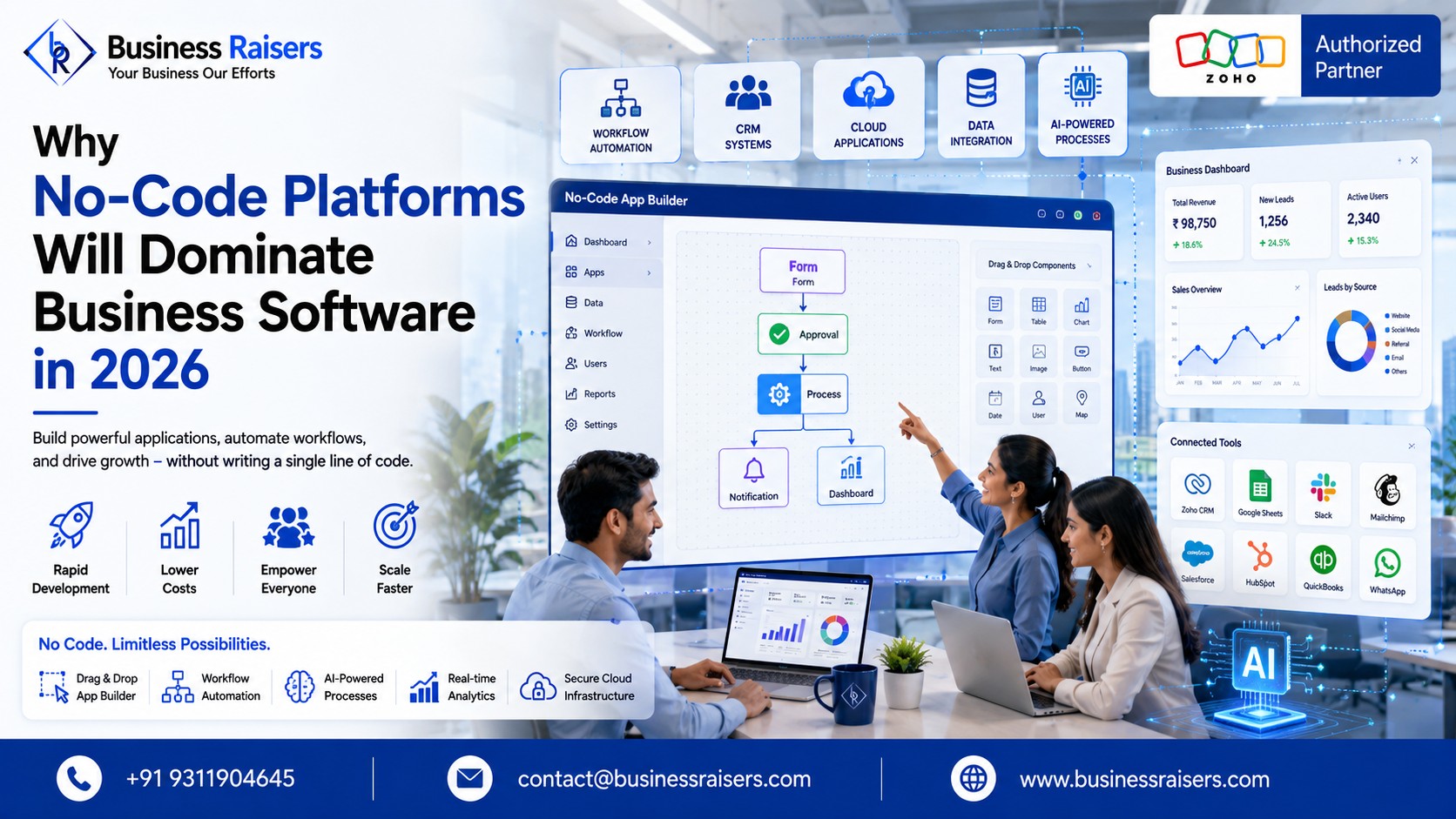
Why No-Code Platforms Will Dominate Business Software in 2026
Businesses are under increasing pressure to move faster, reduce operational costs, and adapt to changing customer expectations. At Business Raisers, we have seen organizations increasingly work with a zoho consulting partner to simplify operations, accelerate digital transformation, and build scalable business systems. In the past, developing custom software required significant budgets, lengthy development cycles, and highly specialized technical teams. Today, no-code platforms are changing the way businesses approach technology by making software development faster, more affordable, and accessible to non-technical users.
As digital transformation continues to reshape industries, no-code technology is becoming a powerful solution for businesses that want to innovate without the complexity of traditional software development. From automating workflows to creating business applications, no-code platforms are helping organizations improve efficiency while responding quickly to changing market demands.
What Are No-Code Platforms?
No-code platforms are software development environments that allow users to create applications through visual interfaces rather than writing complex code. Using drag-and-drop components, workflow builders, and pre-configured templates, businesses can develop custom solutions that support their operations without relying heavily on software developers.
This approach significantly reduces the barriers associated with application development and allows organizations to focus on solving business challenges rather than managing technical complexities.
As businesses seek faster ways to modernize operations, no-code platforms are becoming a critical part of their digital transformation strategy.
Why Businesses Are Rapidly Adopting No-Code Solutions
The demand for business agility has never been higher. Companies need systems that can adapt quickly to market changes, customer expectations, and operational requirements.
Traditional software projects often take months to complete, requiring extensive planning, development, testing, and deployment. By contrast, no-code platforms allow organizations to create and launch applications in a fraction of the time.
This speed gives businesses a competitive advantage by enabling them to:
- Respond faster to market opportunities
- Automate repetitive processes
- Improve operational efficiency
- Reduce software development costs
As a result, businesses can focus more on growth and innovation rather than technical challenges.
Faster Development Means Faster Results
One of the biggest reasons no-code platforms are gaining popularity is their ability to accelerate software development.
Organizations can create applications for:
- Employee onboarding
- Lead management
- Customer support
- Approval workflows
- Inventory management
Without extensive coding requirements, teams can quickly develop solutions that address immediate business needs. This reduces dependency on external developers and shortens implementation timelines.
Faster development cycles also allow businesses to experiment with new ideas, improve processes, and adapt systems whenever requirements change.
Empowering Non-Technical Teams
Historically, software development was limited to IT departments and professional developers. No-code technology changes this by empowering employees across departments to create solutions independently.
Marketing teams can build campaign tracking systems, HR departments can automate employee processes, and operations teams can create workflow applications without waiting for development resources.
This democratization of software development improves productivity and encourages innovation throughout the organization.
Employees closest to business challenges can often create practical solutions faster than traditional development teams, leading to better outcomes and greater efficiency.
Improving Customer Relationship Management
Customer expectations continue to evolve, and businesses need systems that help them deliver better experiences.
Organizations using zoho crm consulting services can build customized lead management processes, sales workflows, and customer engagement systems without extensive development efforts.
No-code platforms allow businesses to automate customer communications, track interactions more effectively, and improve sales performance through streamlined processes.
This enables organizations to create stronger customer relationships while improving operational efficiency.
Enhancing Customer Support Operations
Providing excellent customer support is essential for long-term business success. Modern customers expect quick responses and efficient issue resolution.
An experienced zoho desk consultant can help businesses implement no-code workflows that automate ticket routing, customer notifications, escalation processes, and service management activities.
These automated workflows reduce manual effort while improving service quality and customer satisfaction.
Businesses can deliver faster support experiences while ensuring their teams remain focused on solving customer problems rather than managing repetitive administrative tasks.
Creating a Unified Business Ecosystem
Many organizations struggle with disconnected software systems that create data silos and reduce productivity.
Through effective zoho one implementation, businesses can connect multiple departments and processes within a single ecosystem. Sales, finance, HR, customer support, and operations can all work from centralized data, improving collaboration and decision-making.
A unified business environment offers several advantages:
- Better visibility across departments
- More accurate reporting
- Improved collaboration
- Faster business decisions
When teams work with connected information, organizations become more agile and efficient.
Reducing Software Development Costs
Software development is often one of the most expensive components of digital transformation projects.
No-code platforms significantly reduce costs by eliminating much of the coding, testing, and maintenance traditionally required for application development.
Businesses can achieve more with fewer resources while maintaining flexibility and scalability. This makes no-code technology particularly attractive for startups, small businesses, and growing enterprises seeking cost-effective solutions.
Lower development costs also enable businesses to invest more resources into growth initiatives and customer experience improvements.
Supporting Business Agility and Innovation
The business landscape continues to evolve rapidly. Organizations must adapt quickly to remain competitive.
No-code platforms provide the flexibility needed to launch new applications, automate processes, and improve workflows without lengthy development cycles. This ability to adapt quickly enables businesses to respond to customer demands and market changes with greater confidence.
Innovation is no longer limited by technical resources. Teams can test ideas, implement improvements, and optimize operations faster than ever before.
As businesses continue to seek competitive advantages, no-code technology will play an increasingly important role in driving innovation.
Why No-Code Platforms Will Lead Business Software in 2026
Several factors are contributing to the growing dominance of no-code platforms:
- Rising demand for business automation
- Shortage of skilled software developers
- Increasing software development costs
- Need for faster digital transformation
- Greater focus on operational efficiency
Organizations are looking for solutions that combine speed, flexibility, and affordability. No-code technology delivers all three, making it one of the most valuable business software trends of 2026.
Businesses that embrace no-code platforms today will be better prepared to innovate, scale, and compete in an increasingly digital economy.
Conclusion
No-code platforms are fundamentally changing how businesses develop software, automate processes, and manage digital transformation. By reducing development complexity and empowering non-technical users, these platforms are helping organizations become more agile, efficient, and innovative.
Whether improving customer relationships, automating support operations, or streamlining internal workflows, no-code technology enables businesses to achieve more with fewer resources.
As digital transformation accelerates throughout 2026 and beyond, no-code platforms will continue to dominate business software by making innovation accessible to organizations of every size.
Contact Business Raisers for expert Zoho implementation, automation, and digital transformation solutions that help your business grow faster and operate more efficiently.
FAQs
1. What is a no-code platform?
A no-code platform allows users to build applications, automate workflows, and manage business processes through visual tools without writing code.
2. Why are businesses adopting no-code software?
Businesses use no-code solutions to reduce development costs, improve efficiency, and accelerate digital transformation.
3. Can no-code platforms support growing businesses?
Yes. Most modern no-code platforms are scalable and can support increasing users, workflows, and operational requirements.
4. How do no-code platforms improve productivity?
They automate repetitive tasks, simplify workflow management, and allow teams to create solutions without relying heavily on developers.
5. Will no-code platforms replace traditional software development?
No-code platforms complement traditional development by enabling faster creation of business applications while reducing development workloads for many business processes.